Visualizing and Analyzing Data
Available Data on Lay is Inconclusive
The above graph represents the average lay of workers within our desired time period. Recall that a central purpose of this project is to investigate upward social mobility of workers of different races, and particularly for the whaling industry, exploring the variation in take-home pay for workers through lay is an apt proxy. Unfortuneately, there are two hurdles in the way of that analysis. Firstly, lay data that is available for only the first-half of the whaling timeline. We are interested in a comparison with the later years of whaling as primary sources cite those times as when people of color experienced greater oppurtuinty in the industry. Secondly, of the lay data available, none of it can be accurately segmented by race. Using a proxy of Metaphonic clustering as outlined prior is highly inaccurate and would fail to produce defendable conclusions. Perhaps the only thing that can be deduced from the lack of data is that records of lay came second to records of overall catch.
There are many documented records of amounts of whale oil produced by trips available from the New Bedford Customs House; however, lay records are unrecorded just around the decline of the whaling industry. This might make more sense as a customs house in more interested in quantities brought back to land as opposed to how profits are split at sea. Our next best proxy then is to use complete, cleaned, and accurately segmented data on whale oil brought back to land. Note that lay is read as a reciprocal on the y-axis of the above graph i.e. higher numbers translate to less pay.
Upwards Social Mobility in the Later Half of the Whaling Industry

The above graph plots average oil carried by white-only ships versus mixed-ships (ships with both white and black crew members) across the whaling history timeline. Before the analysis, there are a few discrepencies to note. Firstly, data for the years 1835-39 and 1895-97 is underpopulated and not representative of the whaling industry as portrayed by other primary sources. Census data to correct, or attempt to correct, these deficiencies is available for the Nantucket Customs House, but not the New Bedford Customs House. Secondly, the x-axis is a continous timeline as the inputs are exact date, month, and year quantities. Lastly, it appears as though the distribution of the white-only v. mixed records follows too closely; however, this is a result of tableu smoothing and merging areas together when visualized. For a quick explanation, tableau first plots stacked bar charts and then blends them together when viewed on a continuous timeline. This is why peaks and troughs may seem to follow each other so closely; other visualizations that do not communicate as much information as I would like, like line graphs, do not have this deficiency.
Up until the discovery of petroleum in the late 1850's, white-only ships averaged greater oil carried back to land compared to mixed ships. However, as white workers left en masse for new oppurtunities on land, the trend flips with mixed-ships carrying more oil on average that white-only ships. Black people did not have the same oppurtunity to pursue a career in the oil industry, especially since their freedoms were still quite limited in the emancipated state of Massachusetts, and so they found greater social mobility at sea. As oppurtunity opened up at sea, it would appear that ships became more accustomed to hiring people of all backgrounds. Additionally, black people, who are experienced in the field, more hardworking, and now lack a white-competitor, could be promoted to higher ranks, supporting the idea that mobility is found at sea and motivating black people to continue to pursue a career in whaling. Lastly, it also appears that in later years that ships of all races were more successful on average than in the booming years of whaling. In a crowded market, there is a lot of room for both success and failure. However, in a quiet industry where only veterans remain, success was more likely.
Mixed Race Ships Performed Better than their Counterparts

In the years where whaling was fifth largest economy of the United States, mixed race ships performed better then white-only ships. Hiring practices for ships are determined by captains, and so, it seems that captains who employed all talent saw greater fortune in their trips. A logical explanation for this, as Farr notes, is that black workers often worked harder than their counterparts. A captain motivated by wealth and not racial prejudice will hire the more-skilled worker regardless of race, and thus, reap his reward.
These results also support the narrative that when white people left the industry for petroleum, black people who still found a semblance of equality at sea continued through with their jobs in whaling. Total oil carried in the last twenty years of the industry is approximately three times higher in mixed-ships than white-only ships.
As Whaling Declined, Variability of Success of Trips Increased

For more information on how to interpret this plot, please read here. While not entirely conclusive or ground-breaking, the above plot seems to indicate that there was greater variability (or difference between the upper and lower quartiles) in average pay in the years of whaling's decline.
People of Color Travelled Farther for Careers in the Industry

The above map shows the hometown of people who worked in the New Bedford whaling industry classified as white, black, or mulatto (half-white and half-black). The plotted dots are displayed and condensed for only five or more entries to be read with some significance. It's clear that the New England area was homebase for many people involved in the industry. However, as you move farther away from New Bedford, it is just as clear that the people who travelled far and wide to risk their lives at sea were disproportionately people of color. This is particularly noticable for populations on the west coast and in the south, indicating just how different the standard of living was for people of color across America and at sea.
Whaling was Not a Safe Means to and End
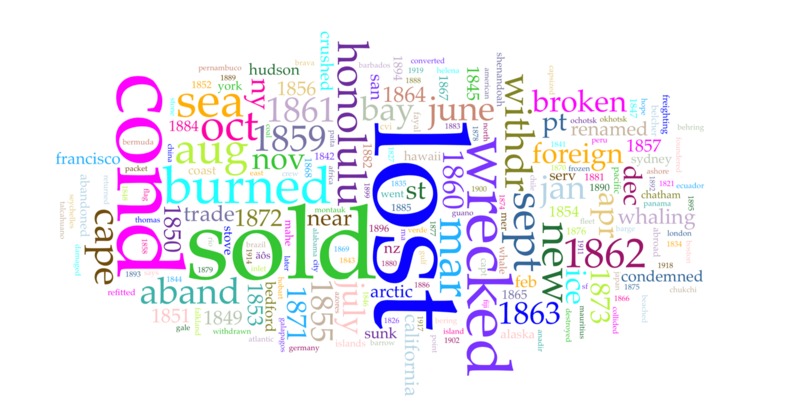
Historians and data scientists have called word clouds harmful and lame visualization methods. I don't intend to claim an industry-shocking hypothesis from the above visualization. The profound and real risks of the whaling industry are well-documented and this word cloud tells a similar story. As we attempt to understand what degree of social mobility people of color had at sea throughout the whaling industry, it is imperative to note that despite the risk of being lost, wrecked, burnt, or sunk at sea, people of color still chose to sail on troubled waters. Well-aware of the relative safety of life on land, black men continued to risk their lives at the mercy of the oceans, well-after white man had quit, in search of a greater purpose.